Binary Indexed Tree
Some data structures feel much more complicated than they really are because of notation.
Binary Indexed Tree, or Fenwick Tree, is one of them.
The first time you see it, it looks like magic: idx & -idx, mysterious parent jumps, prefix sums appearing from nowhere. But the core idea is actually very small. It is just a way to store prefix information in overlapping power-of-two blocks, so both update and query stay logarithmic.
That is why this structure keeps showing up in contests. It solves one very common problem extremely well:
- update one position
- query a prefix sum
And from that, you also get range sums:
If all you need is that, Fenwick Tree is usually the cleanest tool.
The Real Idea
Suppose we have an array:
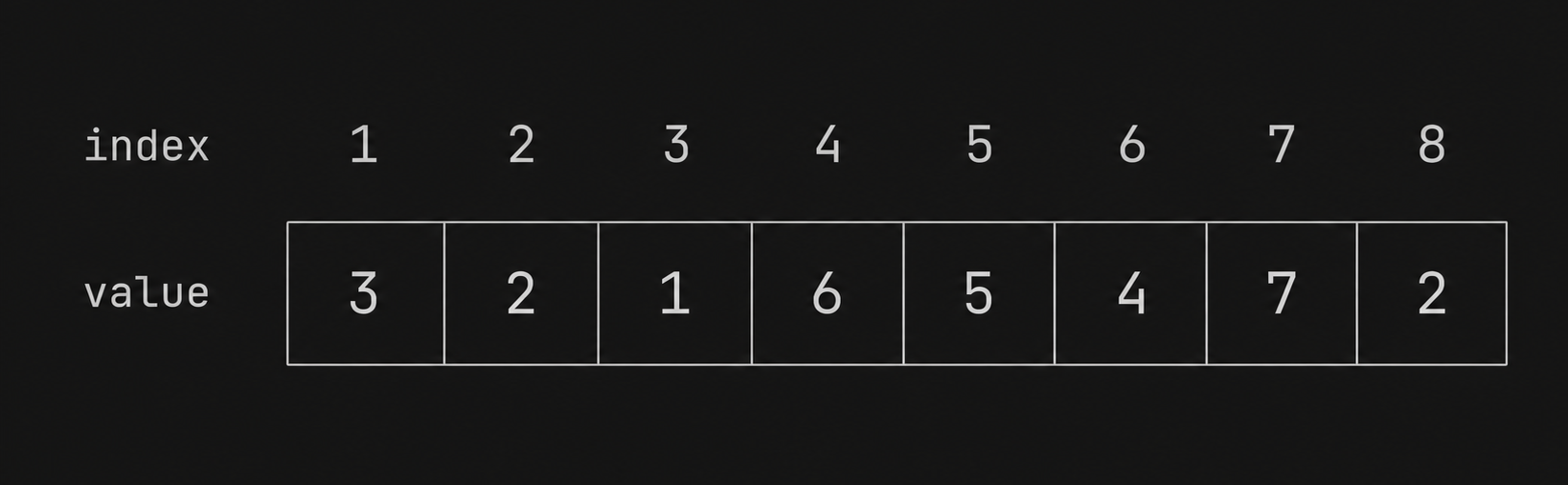 Sidenote: The indices are 1-based here, and the Fenwick tree is built on top of this underlying array.
The naive way to answer sum(1, r) is to add everything from 1 to r, which takes O(n) in the worst case. The naive way to support updates is to change the element directly, which is O(1). The problem is that this gives us an asymmetric tradeoff: updates are cheap, but queries are not. Fenwick Tree improves that balance by making both operations O(log n).
For example, if we perform n point updates and n prefix-sum queries, the naive total cost is n * O(1) + n * O(n) = O(n^2). With a Fenwick Tree, the same workload becomes n * O(log n) + n * O(log n) = O(n log n).
Fenwick Tree does this by giving each position i responsibility for a small suffix ending at i.
The size of that suffix is determined by the last set bit of i.
For example:
tree[1]stores 1 valuetree[2]stores 2 valuestree[4]stores 4 valuestree[6]stores 2 valuestree[8]stores 8 values
![A chart of Binary Indexed Tree ranges for indices 1 through 8, showing that BIT[1] covers 1, BIT[2] covers 1 through 2, BIT[3] covers 3, BIT[4] covers 1 through 4, BIT[5] covers 5, BIT[6] covers 5 through 6, BIT[7] covers 7, and BIT[8] covers 1 through 8.](bit-ranges.png)
Each tree[i] stores a contiguous block ending at i, with length lowbit(i).
So tree[i] does not store arr[i]. It stores the sum of the last lowbit(i) elements ending at i.
For example:
tree[1] = arr[1]tree[2] = arr[1] + arr[2]tree[6] = arr[5] + arr[6]tree[8] = arr[1] + arr[2] + ... + arr[8]
That one sentence is the whole data structure.
Why idx & -idx Works
The function usually called lowbit is:
int lowbit(int x) {
  return x & -x;
}
It isolates the least significant set bit.
Examples:
lowbit(6 = 110₂) = 2 = 10₂lowbit(12 = 1100₂) = 4 = 100₂lowbit(8 = 1000₂) = 8 = 1000₂
This gives the block size for tree[i].
So:
tree[6]stores the sum over[5, 6], becauselowbit(6) = 2, so the block has length 2 and starts at6 - 2 + 1 = 5tree[12]stores the sum over[9, 12]tree[8]stores the sum over[1, 8]
At that point the query logic becomes almost obvious.
Reading a Prefix Sum
To compute the sum from 1 to idx, we keep taking the block that ends at idx, then jump left by that block size.
int query(int idx) {
  int sum = 0;
  while (idx > 0) {
    sum += tree[idx];
    idx -= idx & -idx;
  }
  return sum;
}![A Binary Indexed Tree traversal diagram for i equals 6, highlighting BIT[6] and BIT[4] and showing that subtracting lowbit moves the query from index 6 to index 4.](bit-query-traversal.png)
We move by index, not by stored value. For example, starting at i = 6, we read tree[6] and then jump to 4 by subtracting lowbit(6).
Why does this work? Because these blocks partition the prefix perfectly.
Take idx = 6:
- first use the block ending at
6 - then jump to
4 - then use the block ending at
4 - then jump to
0
So the prefix is decomposed into a few non-overlapping chunks. Each jump removes one set bit. That is why the loop is logarithmic.
This is the part I like most about Fenwick Tree: the bit trick is not some optimization layered on top of the structure. The bit trick is the structure.
Updating a Position
Now suppose a[idx] += delta.
Which tree entries should change? Exactly the ones whose covered interval includes idx.
Fenwick Tree gives a very compact way to enumerate them:
void update(int idx, int delta, int n) {
  while (idx <= n) {
    tree[idx] += delta;
    idx += idx & -idx;
  }
}
This loop walks “upward” through larger and larger blocks that still contain the index.
That symmetry is what makes the structure elegant:
- query moves backward by subtracting
lowbit - update moves forward by adding
lowbit
Once you see that, the implementation is hard to forget.
Why It Feels Better Than a Segment Tree
A segment tree is more general. It supports more shapes of queries and is often easier to extend with lazy propagation, custom merges, or range updates.
But if the problem is just:
- point update
- prefix sum or range sum
Fenwick Tree is often better.
It has a few nice properties:
- the code is tiny
- the memory is linear, usually just one array
- constants are small
- the implementation is harder to get wrong under contest pressure
That last point matters. There are data structures that are theoretically simple but practically fragile. Fenwick Tree is the opposite. Once the indexing is right, it tends to stay right.
Where People Get Confused
There are two common sources of confusion.
First: it is usually written with 1-based indexing. That feels annoying at first, but it makes the bit arithmetic clean. You can implement 0-based variants, but the standard 1-based version is easier to reason about.
Second: tree[i] is not a node in the way people imagine a tree node. The “tree” here is really implicit. What you store is just an array, and the parent/child relations come from index arithmetic. If you expect a visible binary tree like a segment tree, the structure feels more mysterious than it is.
I think the name “Fenwick Tree” is actually less misleading than “Binary Indexed Tree”. The latter sounds like some exotic bit-indexing trick, while the former nudges you to treat it as a specific representation with its own rules.
The Right Mental Model
If I had to explain Fenwick Tree in one paragraph, I would say:
It is a prefix-sum structure where position
istores the sum of a block ending ati, and the size of that block is the value of the least significant set bit ofi.
Everything else follows from this.
- Query a prefix: keep removing the last set bit.
- Update a point: keep adding the last set bit.
- Range sum: subtract two prefixes.
That is all.
Limits
Fenwick Tree is not a universal replacement for segment trees.
It is best when the operation behaves nicely with prefix decomposition, especially for sums and frequencies. It is also great for coordinate-compressed counting problems: inversions, order statistics, offline sweeps, counting how many values are <= x, and so on.
But once the problem becomes more structural, the elegance starts to fade. If you need arbitrary range minimum with updates, complicated lazy operations, or rich per-segment state, segment trees are usually the more honest tool.
Fenwick Tree wins by being narrow.
Final Thought
I like Binary Indexed Tree because it is one of those rare contest data structures that feels both clever and justified.
It does not hide complexity behind a giant template. It gives you one compact invariant, and then everything else is just movement through binary representation. That makes it a very good example of what elegant algorithm design looks like: not more machinery, just the right encoding.